

Less Shoe, More Money
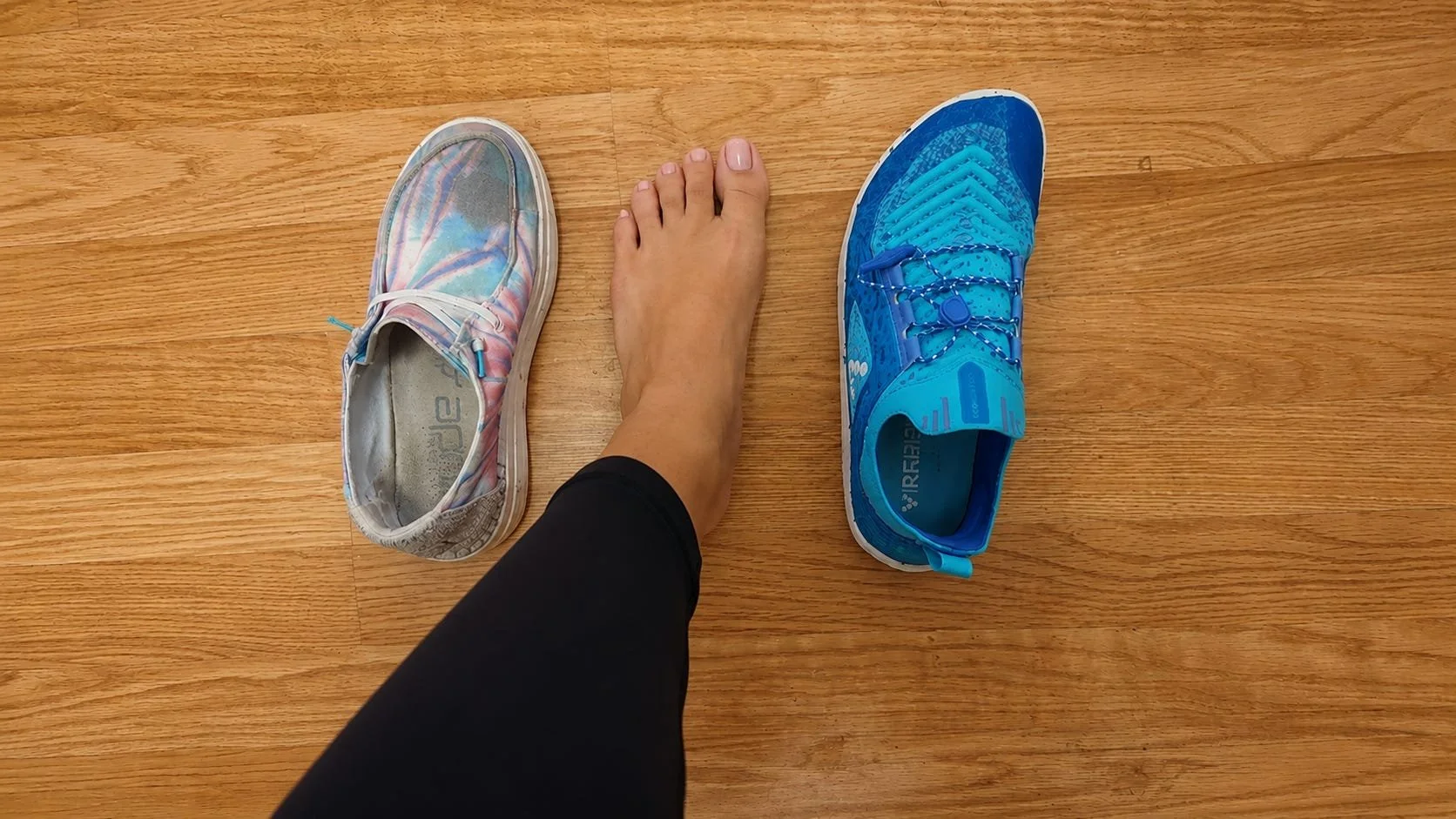
I started going barefoot regularly around 2020, and the thing nobody warns you about is the math.
Somewhere around year two, I’m standing in a store holding a shoe that costs $180. The pitch is that it does less than the shoe next to it. Lower heel. Thinner sole. No arch support. Less cushion.
Less shoe, more money.
Taking your shoes off is free. Been free. Yet the trip back toward that free thing now includes premium brands, seasonal drops and footwear designed to communicate that you have transcended footwear.
Let me be fair before I start acting up. Some of these shoes are genuinely well made. People have wide feet, foot pain, sensory sensitivities and jobs that require shoes even when conventional footwear feels like punishment. After years of stuffing your toes into narrow sneakers, a flexible shoe with room up front can feel like a small act of mercy.
The world also has hot asphalt, broken glass, workplace rules, winter and restaurant managers who would prefer that everybody keep their little piggies under control. Even a soft lawn is probably hiding something sharp, because nature has jokes. Barefoot shoes solve a real problem.
Then the marketing department shows up.
Now a thin, wide shoe represents “natural movement,” “ground feel,” “rewilding,” “regeneration” and freedom from Big Shoe. The foot becomes a suppressed ancestral technology awaiting liberation through e-commerce.
The Luxury of Subtraction
Most athletic shoes justify their price by piling on technology., usually having a proprietary midsole with a name that sounds like a discontinued NASA project.
Minimalist footwear runs the other way. The heel drops, the toe box opens and the cushion gets thinner. Give the foot more room and sensory feedback, the argument goes, and it may remember how to behave like a foot.
There is some evidence behind that modest claim. Research suggests minimalist footwear can strengthen the small muscles inside the foot, with one systematic review finding improvements ranging from 9 to 57%.¹ Wide toe boxes also make plain mechanical sense for toes that would like to spread out instead of living on top of one another like roommates who can’t afford to move.
The body still needs time to adapt. A 2013 study put runners in Vibram FiveFingers for ten weeks using the company’s gradual transition plan. Ten of the 19 participants showed bone marrow swelling. Two developed stress fractures.² Apparently your feet do not care what the onboarding email said.
The useful version of the science is pretty simple: certain people may benefit from more toe room, less heel elevation and gradual strengthening. Barefoot shoes do not automatically prevent injuries, repair posture or reverse a bunion that has been minding its business for 15 years. People with diabetic neuropathy, poor circulation or diminished sensation have even more reason to be careful, because a cut they cannot feel can become a serious medical problem.³
That ain’t enough to build a lifestyle brand, though. So a claim about muscle strength grows into a promise about posture. Ground feel becomes injury prevention. A design choice becomes a philosophy. By the time “proprioception” enters the product description, the price has moved well beyond rubber, thread, labor and shipping.
You’re paying for the story.
The Poverty Marker Became the Wellness Marker
Budget barefoot shoes exist. You can find wide, flexible, zero-drop models for $30 to $50.⁴ Some look like an Amazon algorithm designed them after reading a podiatry blog, but they get the basic shape onto your foot.
Premium models run $130, $180, $230 and higher for boots or handmade versions. Part of that difference is legitimate. Better materials cost more. Ethical manufacturing costs more. Building a sole thin enough to feel the ground and durable enough for months of pavement presents a real engineering problem. A foot-shaped last also requires more thought than widening the toe box on an ordinary sneaker and adding a paragraph about freedom.
The rest of the price buys membership.
You know what zero drop means. You understand toe splay. You can say “proprioception” without sounding like you’re reading a poster in a physical therapy waiting room. Your plain, logo-free shoes tell other informed people that you have seen through the excesses of conventional footwear.
Elizabeth Currid-Halkett describes this kind of signaling as “inconspicuous consumption”: status communicated through knowledge, taste and values instead of obvious luxury branding.⁵ Barefoot shoes fit nicely. They look anti-status while performing the same old status job.
I’m the kind of person who refuses unnecessary things.
Here’s my $180 proof.
The class history makes that signal even stranger. Bare feet traditionally suggested poverty, childhood, rural labor or the simple inability to afford shoes. That meaning still hangs around. Walk barefoot into an office, school or restaurant and see how long everybody remains committed to natural movement.
Barefoot shoes preserve the idea while removing the social penalty. You get nature without dirt, freedom without violating the dress code and the appearance of simplicity in a package acceptable to middle-class public life. The shoeless poor kid and the wellness consumer may have nearly identical amounts of material wrapped around their feet. Only one of them gets praised for being intentional.
The Counterculture Becomes the Catalog
Markets are good at recognizing when refusal has developed a look.
Thomas Frank wrote about advertising’s ability to absorb rebellion and sell it back as consumer identity.⁶ We have watched the process happen with workwear, tiny houses and van life. Necessity becomes an aesthetic. The objects remain similar; the story around them changes the price.
Barefoot footwear follows the same rhythm. The criticism begins reasonably: many conventional shoes are narrow, overbuilt and uncomfortable. Then the criticism becomes a product ladder.
First comes the everyday sneaker. Then the trail shoe, sandal, boot, dress shoe and winter model. Add toe spacers, transition programs, grounding mats and socks shaped like gloves for your feet, because apparently escaping shoes requires a surprising number of accessories.
Free your feet is still an ad.
Much of the modern boom traces back to Christopher McDougall’s 2009 book Born to Run, which introduced millions of readers to the Rarámuri people of northern Mexico and their tradition of running long distances in simple sandals.⁷ The book arrived after years of increasingly engineered running shoes and offered a story people were ready to hear: Maybe all that technology was getting between the body and something it already knew how to do.
Romantic. Also extremely marketable.
Vibram FiveFingers became the symbol of the movement. Those toe shoes looked like somebody made gloves for a frog, but people swore by them. In 2014, Vibram settled a $3.75 million class-action lawsuit over health claims it could not substantiate.⁸ The settlement toned down some of the promises without touching the larger fantasy that modern life had damaged your natural body and the right purchase could return it to you.
Xero Shoes began with $20 do-it-yourself sandal kits inspired by Born to Run. The company later rejected a $400,000 offer on Shark Tank and grew into a multimillion-dollar business.⁹ The story of one of the world’s least expensive running traditions ends with an online catalog and free shipping over $99.
Of course it does.
Then Came the Electrons
At the far end of this market sits grounding footwear.
“Grounding,” or “earthing,” begins with a real physical fact. The Earth has an electrical charge. The human body conducts electricity, and direct contact with a conductive natural surface can equalize electrical potential.
From there, the claims get ambitious: reduced inflammation, improved sleep, lower cortisol, better circulation, faster recovery and anti-aging benefits. The research behind those promises remains limited, but the product category is doing fine. Mats, sheets, straps, conductive laces and shoes sell for roughly $94 to $229.¹⁰ The language lands somewhere between a nature poem and a circuit diagram.
The shoes are the perfect object for this entire business. You can stand barefoot on grass for free. Grounding footwear lets you purchase contact with the Earth while avoiding direct contact with the Earth.
One company says it plainly: “No need to go barefoot to get grounded.”¹¹
There it is.
Why I Bought the Shoes Anyway
A smug joke about people paying for electrons would miss why any of this works. Plenty of mainstream shoes really are too narrow. People with sensory sensitivities experience footwear differently. Folks who stand all day deserve something that does not crush their toes. Some people spent years blaming their feet when the shape of the shoe was the problem.
The desire underneath all this is real too. Modern life is padded, paved, climate-controlled and sealed off. A barefoot shoe offers a small breach. You feel the texture beneath you. You pay attention to where you step. For a little while, your body receives information that has not been filtered through two inches of proprietary foam.
The market gives that desire a name, a vocabulary and eventually a shopping category. Comfort becomes identity. Identity becomes virtue. Virtue needs a trail model for fall.
For the record, I own a pair. Wide toe box, zero drop, recycled mesh—the whole thing. They’re good. I knew the product page was selling me a worldview, and I bought the shoe anyway. The global wellness economy reached an estimated $6.8 trillion in 2024 by turning ordinary desires into premium consumer experiences, and apparently I wanted my data point delivered in recycled mesh.¹²
Or I could just take my shoes off.
Notes
“The Effects of Minimalist Shoes on Plantar Intrinsic Foot Muscle Size and Strength: A Systematic Review.” PubMed, 2022. https://pubmed.ncbi.nlm.nih.gov/35878616/
Ridge, Sarah T., et al. “Foot Bone Marrow Edema after a 10-Week Transition to Minimalist Running Shoes.” Medicine & Science in Sports & Exercise, 2013. https://pubmed.ncbi.nlm.nih.gov/23439417/
“The Do’s and Don’ts of Diabetic Footwear.” Baylor College of Medicine, 2023. https://blogs.bcm.edu/2023/10/04/the-dos-and-donts-of-diabetic-footwear/
Carlson, Anya. “The 10 Best Affordable Barefoot Shoes for Adults.” Anya’s Reviews. https://anyasreviews.com/the-10-best-affordable-barefoot-shoes-for-adults/
Currid-Halkett, Elizabeth. The Sum of Small Things: A Theory of the Aspirational Class. Princeton University Press, 2017. https://press.princeton.edu/books/paperback/9780691183176/the-sum-of-small-things
Frank, Thomas. The Conquest of Cool: Business Culture, Counterculture, and the Rise of Hip Consumerism. University of Chicago Press, 1997. https://press.uchicago.edu/ucp/books/book/chicago/C/bo3618721.html
McDougall, Christopher. Born to Run: A Hidden Tribe, Superathletes, and the Greatest Race the World Has Never Seen. Knopf, 2009.
“Vibram Settles a $3.75 Million USD Lawsuit over Shoes with Alleged Health Benefits.” World Footwear, 2014. https://www.worldfootwear.com/news/vibram-settles-a-375-million-usd-lawsuit-over-shoes-with-alleged-health-benefits/285.html
“Xero Shoes.” Wikipedia. https://en.wikipedia.org/wiki/Xero_Shoes
Earth Runners, “Earthing,” and grounding-footwear pricing overviews. https://www.earthrunners.com/pages/earthing
Harmony 783 brand marketing. https://harmony783.com/
“Statistics & Facts.” Global Wellness Institute, 2025. https://globalwellnessinstitute.org/press-room/statistics-and-facts/