

Why Birkenstock Is Booming While Dr Martens Stalls

Shoe brands Dr Martens and Birkenstock have a lot in common.
Both are mono-brand companies, built on one silhouette you can sketch from memory. Both were invented in Germany by cobblers who thought shoes should be comfortable instead of torture devices. Both found their first fans in subcultures: Docs on factory floors and then punk stages, Birks in health food stores where hippies were buying lentils. Both IPO’d recently, Docs in 2021 and Birks in 2023.
Financially, they are twins: about $1–1.5 billion in revenue, 38% cost of goods, EBITDA margins of 23 to 24%.
And yet, Birkenstock is worth ten times Dr Martens.
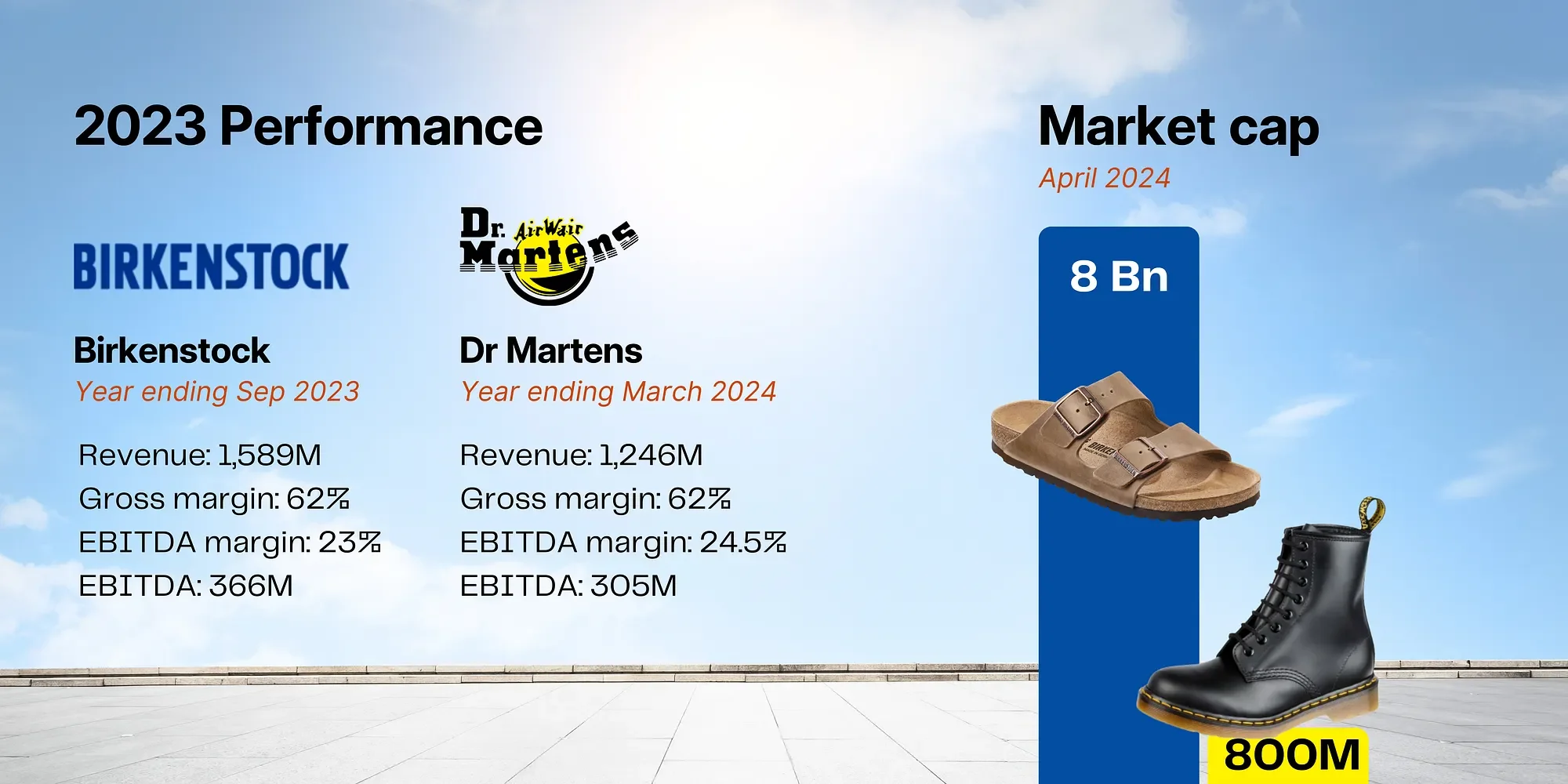
Why the difference in valuation?
One brand is a machine. Birkenstock. The other has stalled. Dr Martens.
A weak holiday season in 2025 forced Dr Martens to forecast "broadly flat" revenue for the full year, but the source of the pain has shifted.
Retail Gazette reported it plainly in January 2026: “Dr Martens saw sales fall in its third quarter (Q3) trading update... The shoe retailer witnessed a 2.7% drop in group revenue year on year. Dr Martens attributed the decline to a weaker direct-to-consumer (DTC) performance.” In a reversal of previous trends, wholesale actually grew 9.5% as retailers restocked, but the brand’s own channels—ecommerce and retail stores—dropped 6.5%, signaling that consumer demand is still soft.
At the same time, Birkenstock was surging. AlphaStreet reported in February 2026: “Birkenstock reported revenue growth of 11% on a reported basis and 18% in constant currency for the fiscal first quarter ended December 31, 2025... driven by holiday demand for products across all categories.”
This past year, Dr Martens CEO Ije Nwokorie has been executing his turnaround plan, titled "Levers for Growth," but he admits the pivot is still a work in progress. His challenge remains clear: stop the bleeding and get people to want Docs again.
Applying the Brand Growth Model
Back in 2024, while researching Hoka’s improbable rise, I built a model for how shoe brands grow. It has two phases: Definition and Scaling.
Definition is about owning a niche. You solve one problem, build for one core community, and back it up with distinctive design or technology. That is how a brand gets its initial footing, with a clear use case and a subculture that claims it. Hoka had ultra-marathoners.
Scaling is different. It is less about inventing new tech and more about expanding to new audiences while keeping the DNA that made the brand distinctive in the first place. Most brands fail here because it feels like moving in opposite directions. Hoka pulled it off. Birkenstock is on its way. The trick is doubling down on what makes you unique while being flexible enough to meet new audiences.
For the full story of how Hoka managed this, see the deeper piece I wrote.
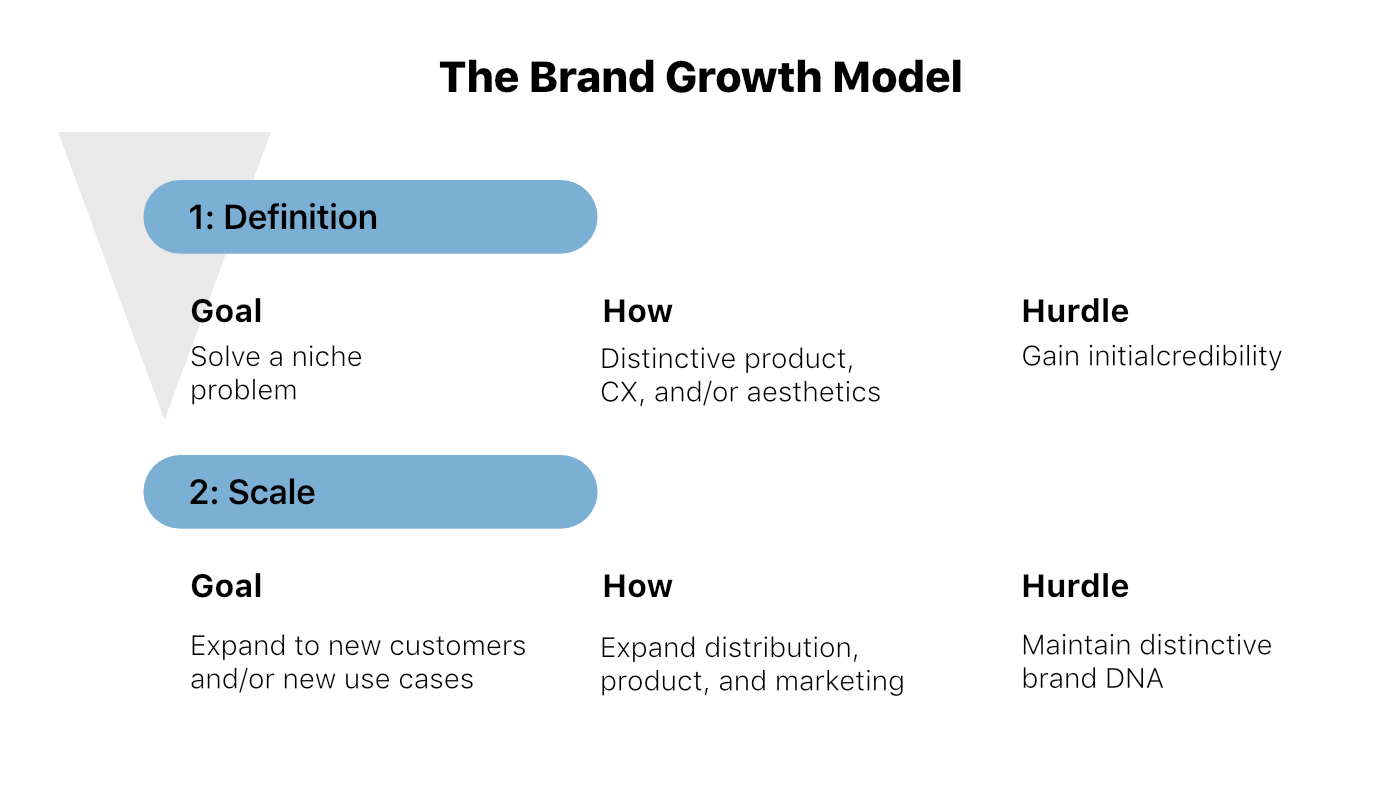
Today is about putting the Brand Growth Model to the test. Two shoes, two paths. Birkenstock, still climbing. Dr Martens, stuck. The model should explain both why Birkenstock looks like a growth machine and what Ije Nwokorie can try if he wants Docs to matter again.
Brand Growth Model Phase 1: Definition
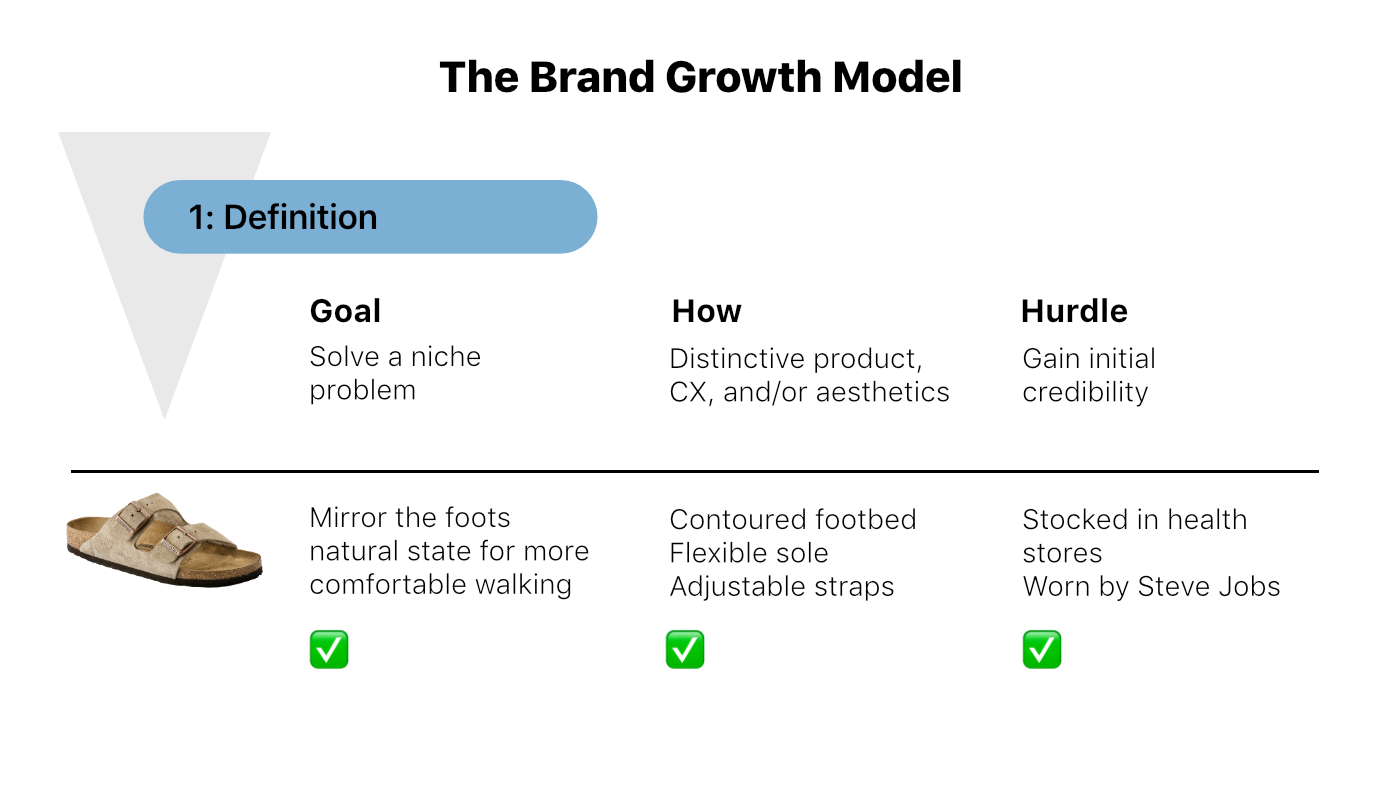
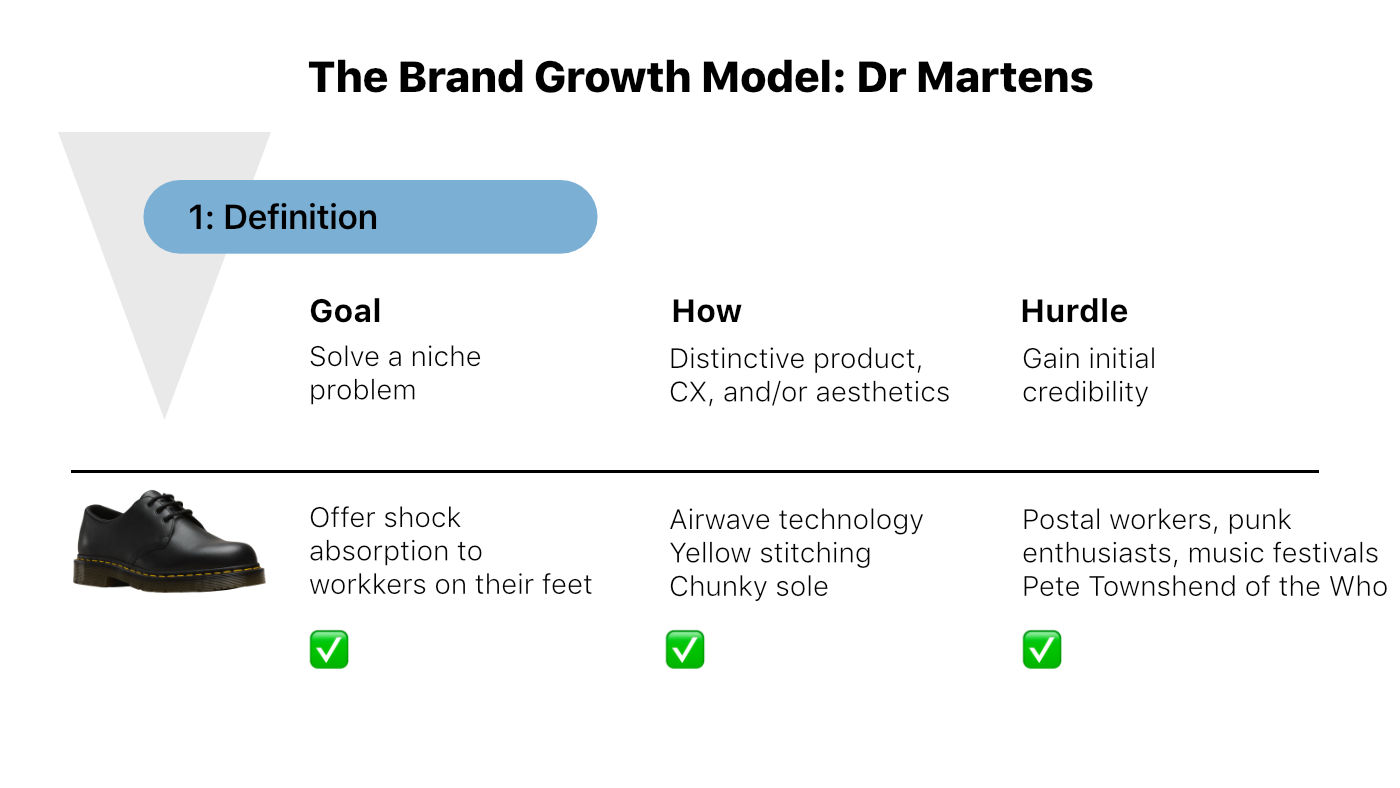
Definition is the starting line. Three boxes to check. Solve a niche problem. Make a product that looks and feels different. Get adopted by a subculture that cares enough to tell everyone else. If you hit all three, you have a shot at $1B in sales. Both Birkenstock and Dr Martens did.
Definition: Birkenstock
Birkenstock’s story goes all the way back to the 1700s, when Johann Adam Birkenstock was making insoles in Germany. For more than a century, his family kept tweaking the idea of what an insole could be. Then in 1896, Konrad Birkenstock came up with the contoured version. Until then, every insole was flat, which is another way of saying uncomfortable. In 1963, Carl Birkenstock finally turned the family’s insole obsession into a full shoe. He called it the Madrid. It had the cork footbed, flexible and deep, and a single wide strap. That blueprint is still what makes a Birkenstock recognizable today.
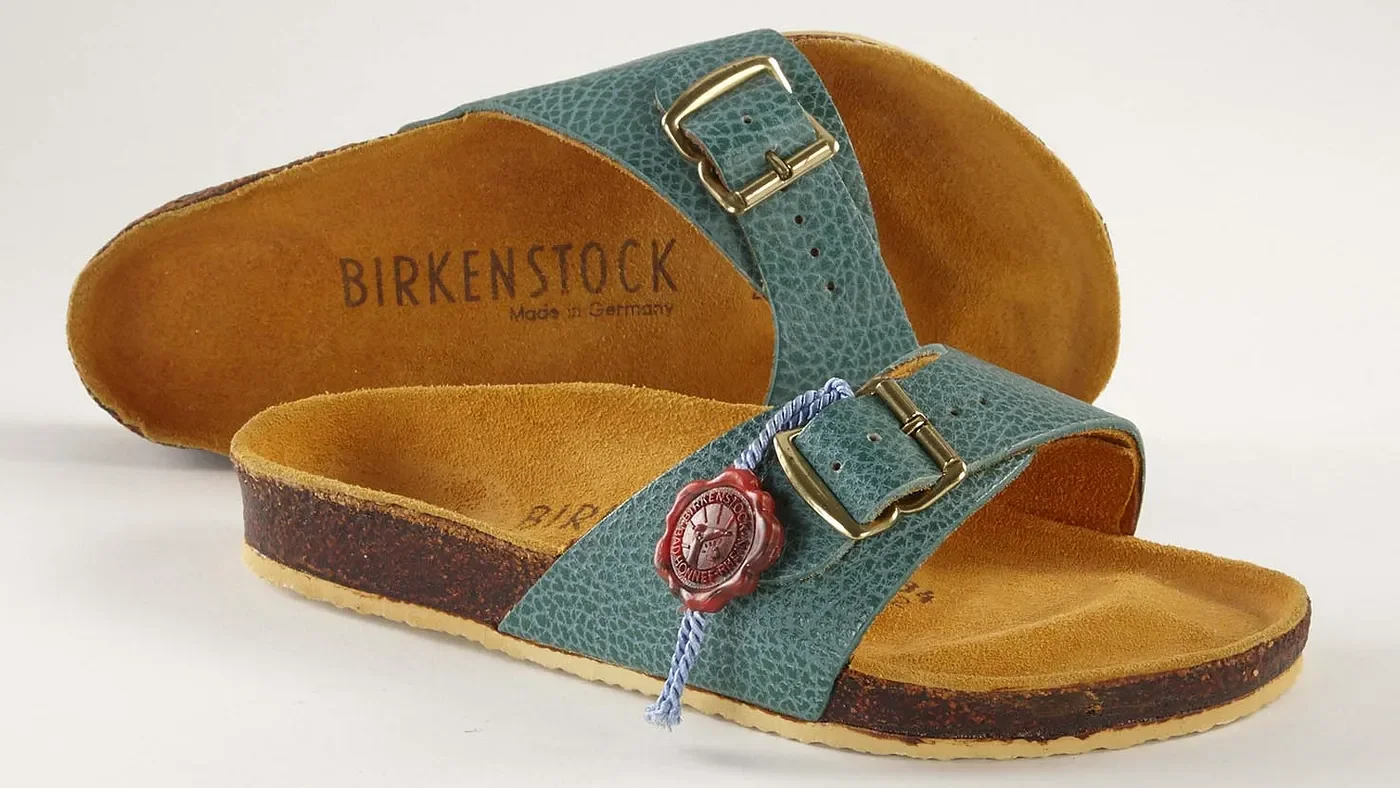
The first Birkenstock shoe, the Madrid, launched in 1963. Source: Birkenstock
Three years later, a Californian named Margot Fraser was on vacation in Germany. She wanted comfortable shoes. She found Birkenstocks. She liked them so much she asked to distribute them back in the U.S. The only stores that said yes were health food shops. Which meant Birks ended up next to bins of lentils and jars of granola.
That placement locked in the brand. As The Cut put it, “Fraser’s best outlets were health-food shops, near the granola. That was the start of Birkenstock USA. People who were against nukes, processed foods, and the sexualization of women wore them. In short, Birkenstocks were the shoe of opposition.”
Steve Jobs wore them too. In the 1970s and 1980s, while building Apple, he was in Birkenstocks. It was the perfect fit: the man creating the future of computers in sandals that looked like they came from a co-op clearance rack.
Comfortable design. Distinctive look. Counterculture credibility. Birkenstock had defined itself completely.
Definition: Dr Martens
Dr Martens also started with a German cobbler. Dr Klaus Maertens broke his foot skiing and realized his standard-issue military boots were basically torture devices. He teamed up with his friend Herbert Funck to design something better. They heat-sealed soles to the uppers, creating “air-tight compartments that cushioned the foot and offered unprecedented support,” as The Rake put it.
Side note: imagine if they had anglicized the name. Dr Funk. History would be different. You cannot tell me a shoe called Dr Funk would not have changed music, fashion, maybe even geopolitics.
Like Birkenstock, the real explosion came when the design left Germany. In 1960, the Griggs company in the UK bought the license to make and sell the boots. They added two crucial pieces. First, branding. They named the shock-absorbing sole “Airwair” and told customers it had bouncing soles. Second, design. They stitched the boots with bright yellow thread. Suddenly, the product was not just comfortable but unmistakable.
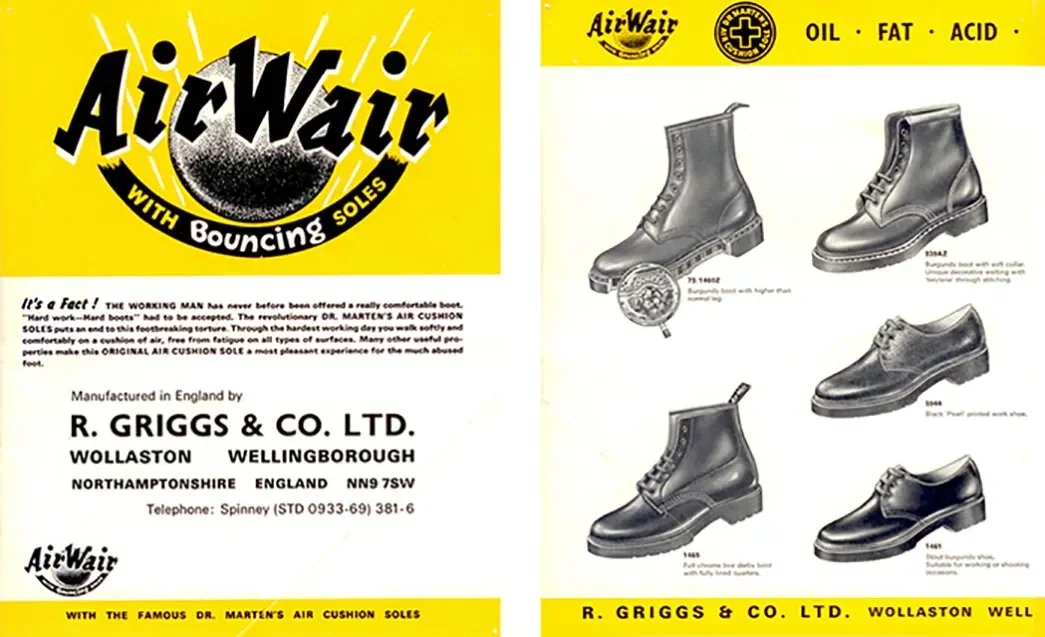
Original ad from Griggs. Source: Beyond Retro
The comfortable sole and the yellow stitching made Docs popular with the English working class. But they crossed into legend when Pete Townshend of The Who wore them on stage. Townshend said directly that his high-energy performances were possible because of the boots: “their toughness combined with their softness and flexibility is what made them so perfect for the pseudo-athletic routines I performed on stage,” as The Rake recorded.
That one detail matters. Docs were no longer just shoes that could survive a shift at the factory. They were shoes that could survive smashing guitars in front of thousands of people. Airwair cushioning, bright yellow stitching, and a working-class identity tied to punk rock gave Dr Martens a permanent place in culture.
Brand Growth Model: Scaling
Scaling means finding new audiences without losing yourself in the process. It is like trying to be more things to more people while still being unmistakably you. Most brands fail here. They either stay too niche and stop growing, or they chase new customers so hard they erase what made them distinct in the first place.
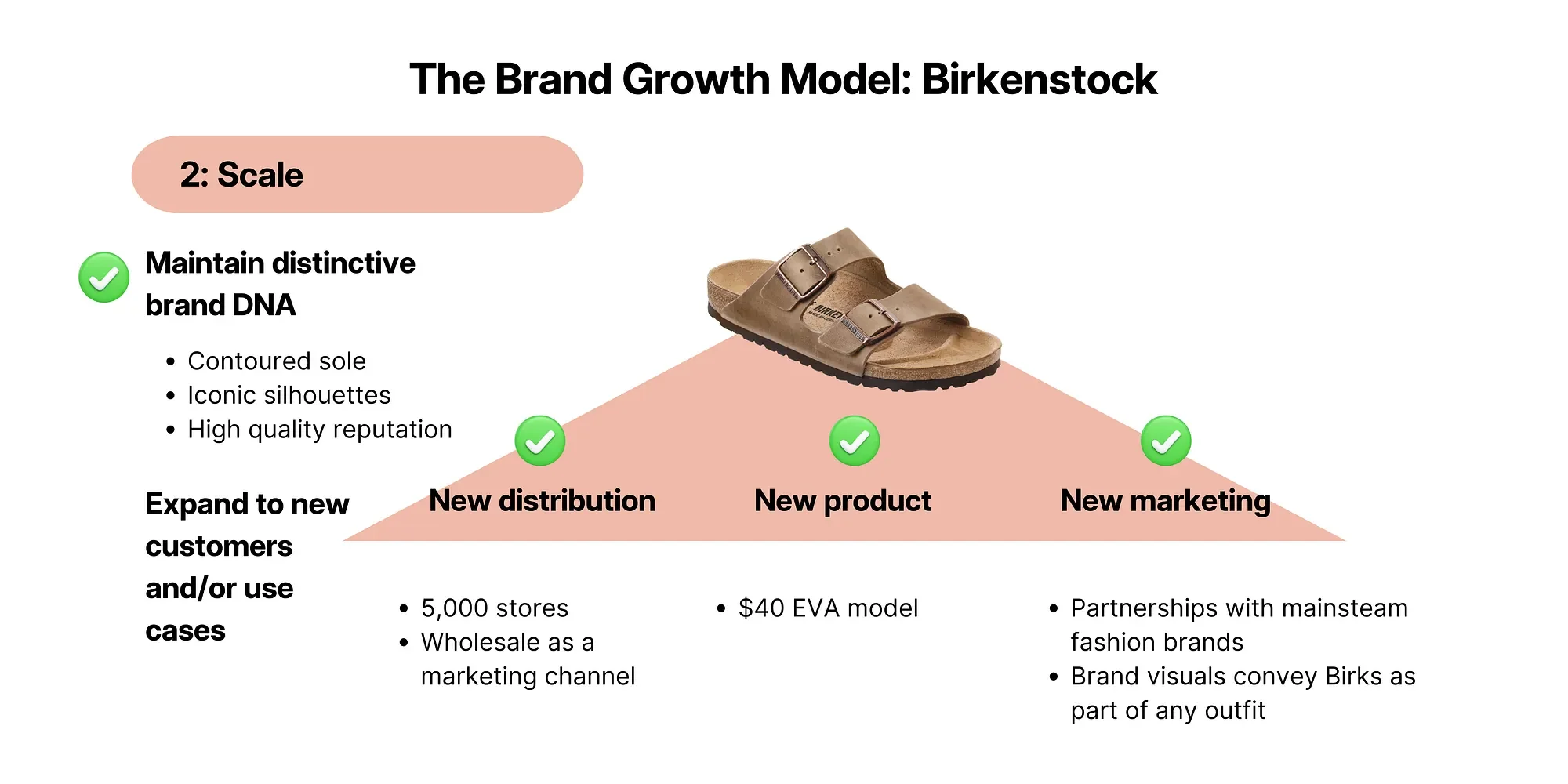
So how did Birkenstock do it? Part of it was pure luck. In 2012, designer Phoebe Philo of Céline sent models down the runway in mink-lined Arizona Birkenstocks. Overnight, Birks went from the shoe of granola shops to the shoe of Paris Fashion Week. The Cut summed it up: “A long dress with a Birkenstock became the new minimalistic chic.” Birkenstock CEO Oliver Reichert even admitted, “The truth is nobody controlled what Céline did with our shoes.”
After that, the company started to make itself more accessible. In 2015, they launched EVA sandals—same Birkenstock shape, same contoured sole, but made out of rubber. They sold for about $40 instead of $100+. Suddenly anyone could try a pair without committing serious money.
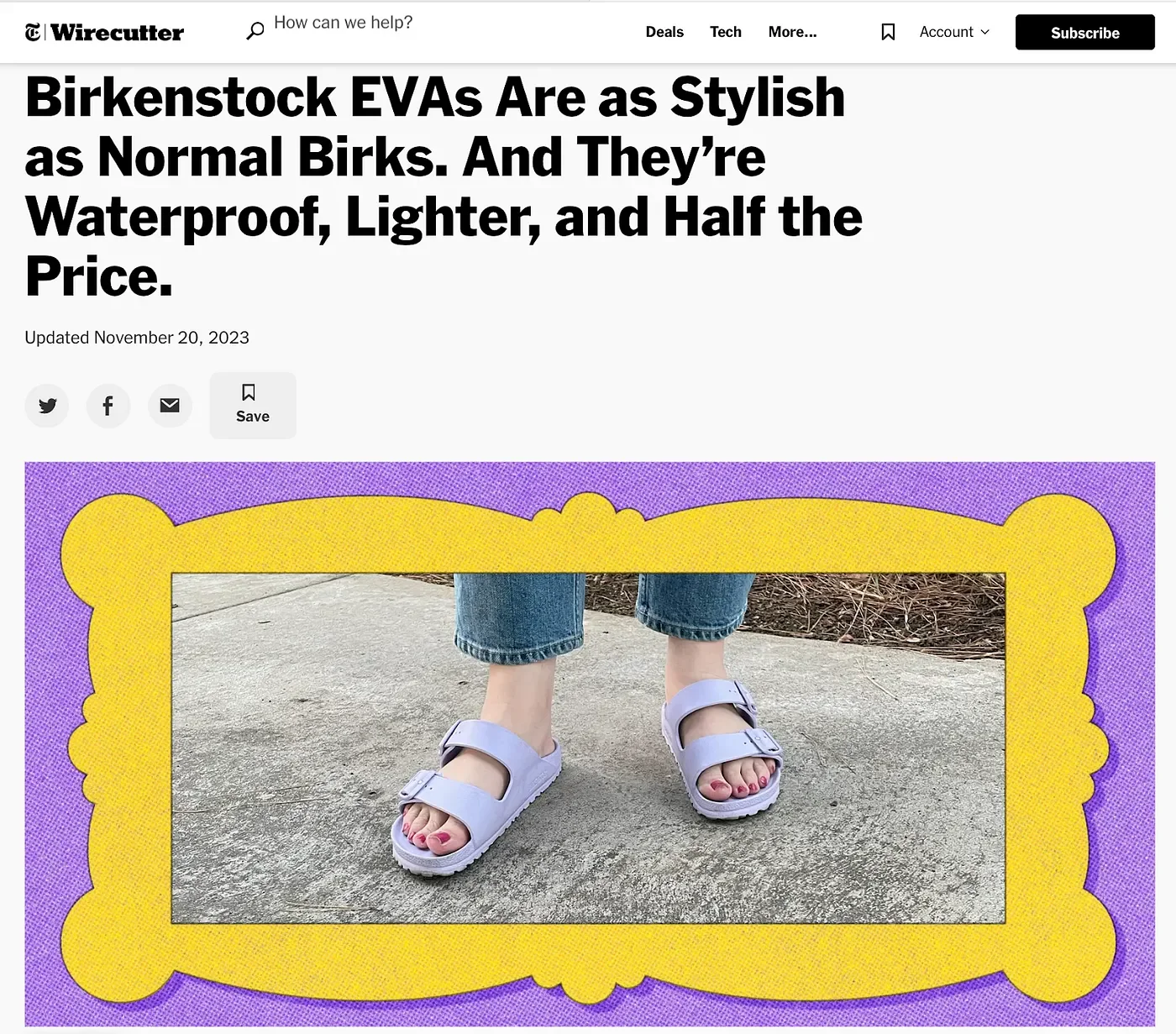
Source: New York Times Wirecutter
And it worked. The EVA line became the perfect gateway drug. But in recent years, Birkenstock found a second, even more powerful lever for scaling: year-round wearability. They realized that to scale, they couldn't just be a summer sandal company. They pushed closed-toe clogs like the Boston, the Naples, and the London. The strategy worked: by fiscal year 2025, closed-toe silhouettes accounted for nearly 40% of the company's revenue. They successfully turned a summer fling into a 12-month relationship.
At the same time, Birkenstock doubled down on the fashion credibility Phoebe Philo had given them. They didn't just rest on the early hits; they industrialized the cool factor. They partnered with Manolo Blahnik. They launched a bridal line with Danielle Frankel. They dropped a braided collection with Kith in late 2025. Each one boosted the brand’s cachet and put Birks on the feet of celebrities and influencers.
The most interesting part, though, is how Birkenstock thinks about distribution. They see wholesale not primarily as sales, but as marketing. Put the shoes in third-party stores, get exposure, then redirect customers to owned channels where the full product line lives. Their IPO filing laid the blueprint: “We operate our channels synergistically, utilizing the B2B channel to facilitate brand accessibility while steering consumers to our DTC channel.” By 2026, the results of this strategy are undeniable. While other brands (like Dr. Martens) saw wholesale as a drag on margins, Birkenstock used it as an acquisition engine. In FY2025, their wholesale channel actually grew over 20%, outpacing their own retail growth.
They also tier their wholesale carefully. Not everyone gets the best stuff. Only select partners have access to premium lines like the “1774” collaborations. It is the same pyramid strategy luxury brands use, where the top products are reserved for the top tier of customers. Again, straight from their IPO filing: “We segment our wholesale product line availability into specific retailer quality tiers… For example, we limit access to our premium 1774 and certain collaboration products to a curated group of brand partners.”
And finally, they pushed their marketing wider. Current Meta ads show Birkenstocks as the universal match: “pair with everything from denim to linen” and “play well with everything in your closet.”
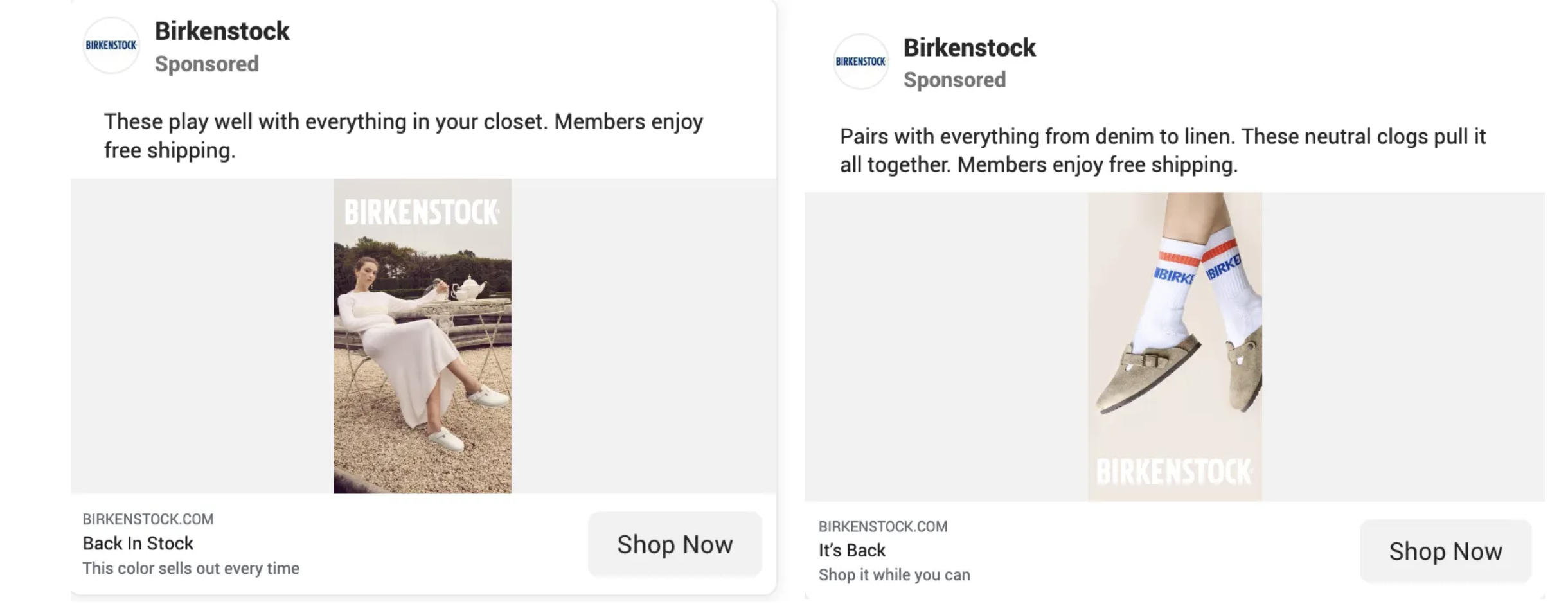
Birkenstock’s ads on Meta in late 2025 made the message simple: these sandals go with everything in your closet. Denim. Linen. Whatever.
Put it all together and the strategy is clear. The lower-priced EVA line brought in new customers. The closed-toe expansion kept them wearing the brand year-round. Distribution worked as marketing. Collaborations with big names gave the brand cultural weight. Through all of that, the contoured footbed stayed constant, which meant Birkenstock kept ownership of the category, even as they scaled to nearly $2.5 billion in revenue.
The Dr Martens team nailed Definition. They built a cultural icon. But today, the brand is fighting a multi-front war: declining revenues, a compressed stock price, and a reputation that needs polishing. So the question is simple: can Docs come back? To figure that out, we need to look at how Docs handled the Scaling phase, where they stumbled, and the specific plan CEO Ije Nwokorie is executing right now to fix it.
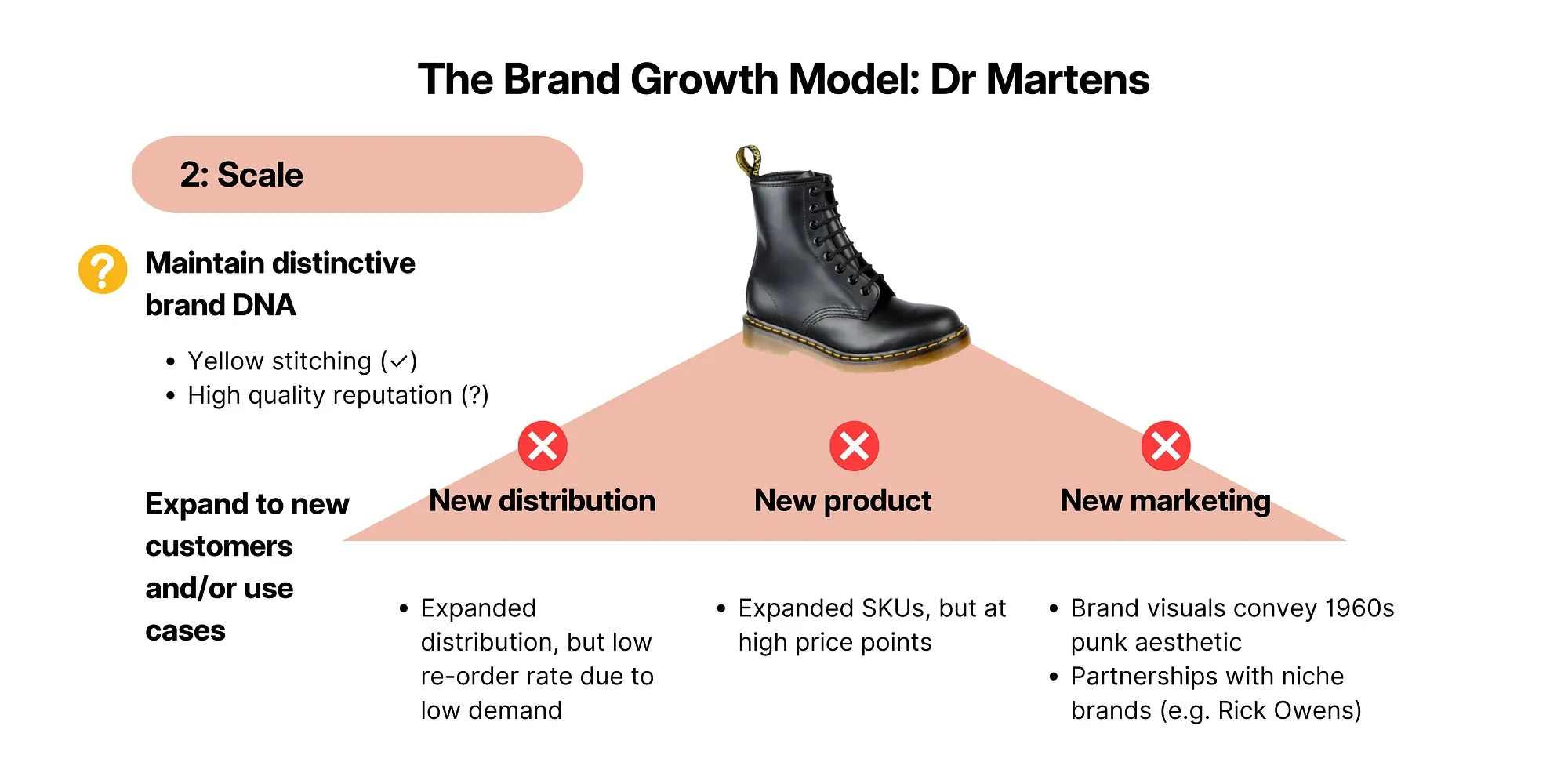
The Wholesale Trap (and the New Twist) Docs’ filings for years spelled out a simple problem: they relied too heavily on wholesale to push volume, and when partners pulled back, the business collapsed. But in early 2026, the story twisted. In their Q3 trading update, wholesale actually grew 9.5% as retailers restocked the boots. The new problem? Direct-to-consumer (DTC) sales dropped 6.5%. This is arguably more dangerous. When wholesale drops, it means buyers are cautious. When DTC drops, it means customers are walking past the store. The "Levers for Growth" strategy, launched in mid-2025, aims to fix this by pivoting from a "channel-first" mindset (just selling wherever) to a "consumer-first" one.
The Pricing & Product Gap Birkenstock used the $40 EVA sandal as a low-risk gateway for new customers. Dr Martens didn't have that. For years, their entry price was effectively $170 for a pair of 1460 boots. That is a massive barrier for a Gen Z shopper curious about the brand. Recognizing this, Docs finally made a move in late 2025 with the launch of the "Buzz" and "Zebzag" collections—lighter, sneaker-adjacent options designed to get people into the brand without the heavy break-in period or the heavy price tag. It is their attempt at the EVA strategy: get them in the door with a lighter shoe, and trade them up to the leather icon later.
The Marketing Mismatch Marketing is what makes someone who has never worn your product suddenly want it. Docs’ roots are in 1960s punk and rock, which made perfect sense at the time. But for too long, Docs stayed frozen in a museum version of punk—plaid, tattoos, mohawks—while culture moved on. The "Made Strong" campaign from a few years ago illustrates this trap perfectly. It celebrates the history, but it feels like a retrospective rather than a call to action. It looks like a museum exhibit of punk rather than something alive in today’s subcultures.
The problem with the “Made Strong Since 1960” campaign (which ran back in 2024) wasn't that it was inaccurate. Docs have been strong since 1960. The problem was that it was boring. The hero video literally told people, “be true to yourself, that is what is going to make you strong.” But it never showed anyone actually doing that. There was no story. No payoff. Just a lot of vague vibes and plaid. As a result, Docs ended up blending into yesterday’s styles instead of standing out today.
Recognizing this, CEO Ije Nwokorie explicitly pivoted the strategy in mid-2025. His new mantra, "relentlessly on product," admits that the brand had gotten too abstract. The goal of the new "Levers for Growth" plan is to stop telling people to "be punk" and start giving them the tools to do punk things—whether that's a lightweight "Buzz" shoe for a festival or a bag for the commute.
But the creative spark still needs to catch fire. The message must fully shift from “I need to be punk to wear Docs” to “I can be punk by wearing Docs.” The boots should feel like a battery pack for your life. Picture it: people in Docs rocking out at a concert, popping open a fire hydrant on a hot day, getting an ear piercing with a new friend for no reason other than it feels good. That is a story worth watching.
One of the best examples of this "action-led" energy comes from Quiksilver, which once staged a campaign where surfers literally set off explosions in a Copenhagen river to make waves. It was illegal. It was reckless. It was also fun, surprising, and made you say, “that’s a cool idea.” Dr. Martens needs that same spark. They need to stop filming models posing in plaid and start filming people breaking rules.
How about collabs?
Dr Martens does collaborations, just like Birkenstock. The problem is where they aim them. Docs partner with art museums. With Rick Owens. With Denim Tears. These are undeniably cool. Rick Owens is cool. But they are not mainstream. They are “if you know, you know” brands. Good for subcultural credibility. Not good if you are trying to expand beyond the niche. That is the question CEO Ije Nwokorie is currently trying to answer. The IPO prospectus painted a picture of global expansion, of reaching a wider audience. But the reality — high prices, narrow targeting, punk aesthetic — points to a brand still speaking mostly to a counterculture that peaked decades ago.
And that leads to the harder question. If Docs are not effectively chasing new audiences, shouldn’t the core customers at least be stable? The data says no. The 6.5% drop in Direct-to-Consumer sales in early 2026 suggests that even the loyalists are pulling back. Fans on Reddit and TikTok have one answer: quality. Multiple threads continue to complain that Docs do not last like they used to. The advice often comes down to “buy competitors” (like Solovair) or “stick to the Made in England line.” That is a brutal reputation hit for a brand that built its identity on toughness. The “Made Strong” campaign felt like an attempt to change perceptions, but if the boots themselves are slipping, marketing cannot carry the load.
Scaling Scorecard Overall, Docs currently score poorly on Scaling, though the "Levers for Growth" plan is finally addressing the root causes.
All is not lost. In fact, despite the falling stock price, Ije Nwokorie still has one of the best jobs on the planet: he gets to polish a genuine icon. The Brand Growth Model gives us a clear scorecard for his "Levers for Growth" plan. Here is where the turnaround stands, and what still needs to happen.
Step 1: Product Quality (Status: In Progress) This is the hardest lever to pull, but the most urgent. Fans already know the “Made in England” line lasts longer. The proof exists. The turnaround depends entirely on closing the gap between the mass-market Asian production and the UK originals. If the boots don't last, the brand dies. It's that simple.
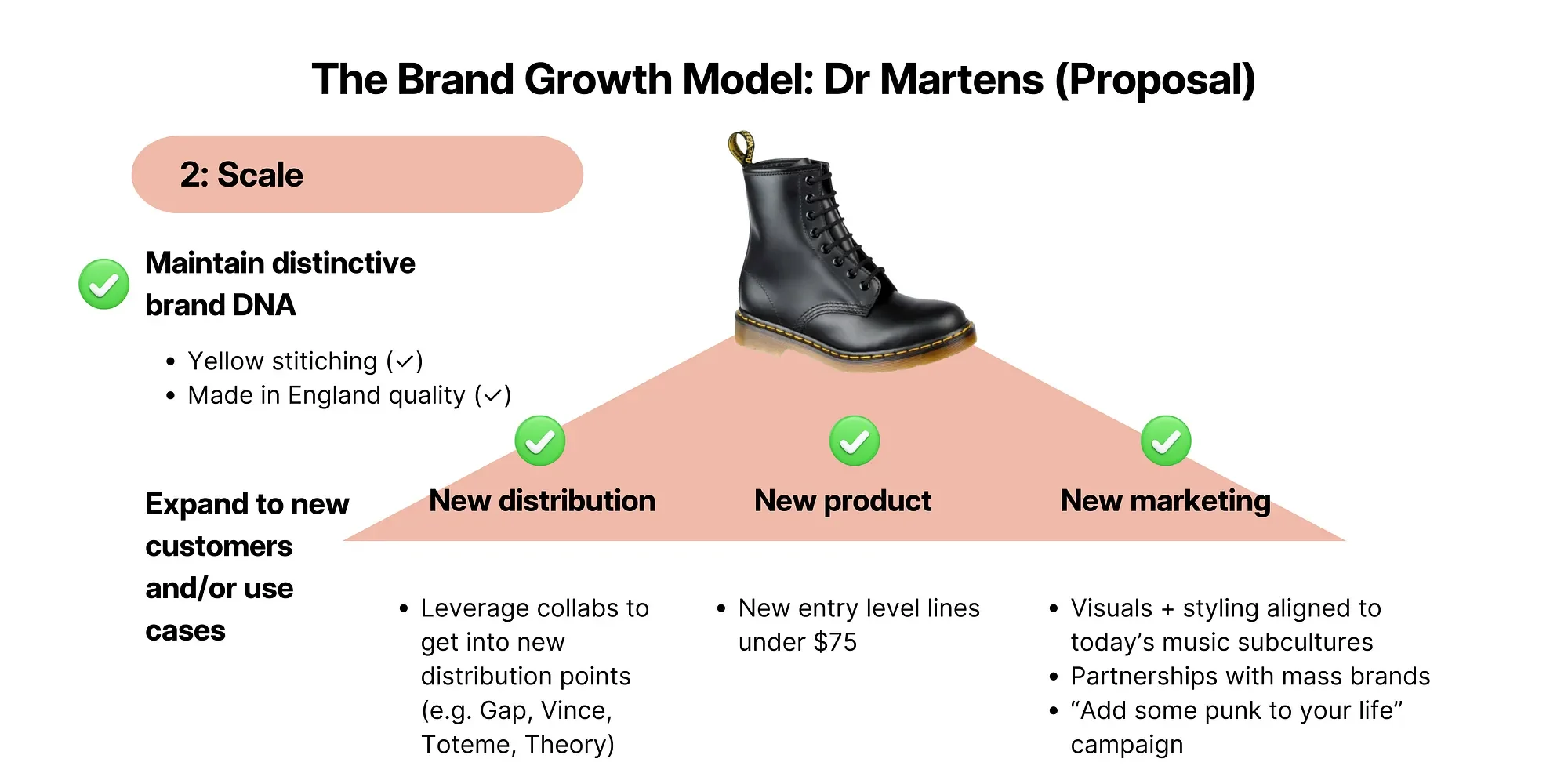
Step 2: Accessibility (Status: Improved) The launch of the "Buzz" and "Zebzag" collections was a critical win. Finally, there is a way to get into the brand for under $100 without waiting for a clearance sale. The challenge now is ensuring these lighter shoes don't dilute the brand's identity. They need to be the "gateway drug" (like Birkenstock's EVA), not just a cheap alternative.
Step 3: Marketing (Status: Needs Spark) Punk rock might be over as a mainstream movement, but the energy that defined it—rebellion, grit, "anti-fashion"—is more relevant than ever in a world of polished Instagram feeds. Nwokorie’s team is moving away from the "museum punk" of the past, but they haven't found their new voice yet. The mandate remains the same: Map out who the modern rebel is. Is it the coder? The activist? The chef? Style Docs in ways that feel contemporary, not archival. The campaign should not be "Look at our history." It should be: "Docs add energy to whatever you do."
Step 4: Collaborations (Status: Missed Opportunity) This is the one area where the strategy is still playing it too safe. Docs are still partnering with niche "cool" brands (Rick Owens, Mm6 Maison Margiela). These preach to the converted. To scale, Docs needs to shock the mainstream. They should take a page from Birkenstock’s playbook and partner with mass brands to inject punk into everyday DNA. My wish list for them remains unchanged:
Gap x Docs: A limited run of denim jackets with leather panels and yellow stitching.
Vince x Docs: Platform sandals styled with silk dresses to break the "heavy" look.
Toteme x Docs: Remake their viral jacket-scarf with yellow stitching.
Revolve x Docs: A festival line sold through Revolve’s pop-ups, complete with a Docs shoe repair booth as an activation.

Sources: Kooples, Vince, Dr Martens, Toteme
One of the smartest things Birkenstock did was treat wholesale as marketing—using partners to recruit new fans. Dr. Martens is finally starting to do this, cleaning up their distribution to ensure the boots show up in the right places, not just the discount bin.
Scaling Dr Martens
I am not a customer of Dr Martens. But watching this turnaround attempt has made me root for them. The icon is still there. The "sneaker fatigue" in 2026 is realer than ever—people are tired of fragile knit shoes. They want something real. The growth strategy is not fantasy. It is built on the same principles that worked for Hoka and Birkenstock. Expand while staying true to what makes the brand distinctive. Ije Nwokorie has pulled the levers. The machine is starting to hum. Now we just have to see if the engine catches before the fuel runs out.