

The Secret History of Rainbow Sandals: How Environmental Law Built a Cult Brand
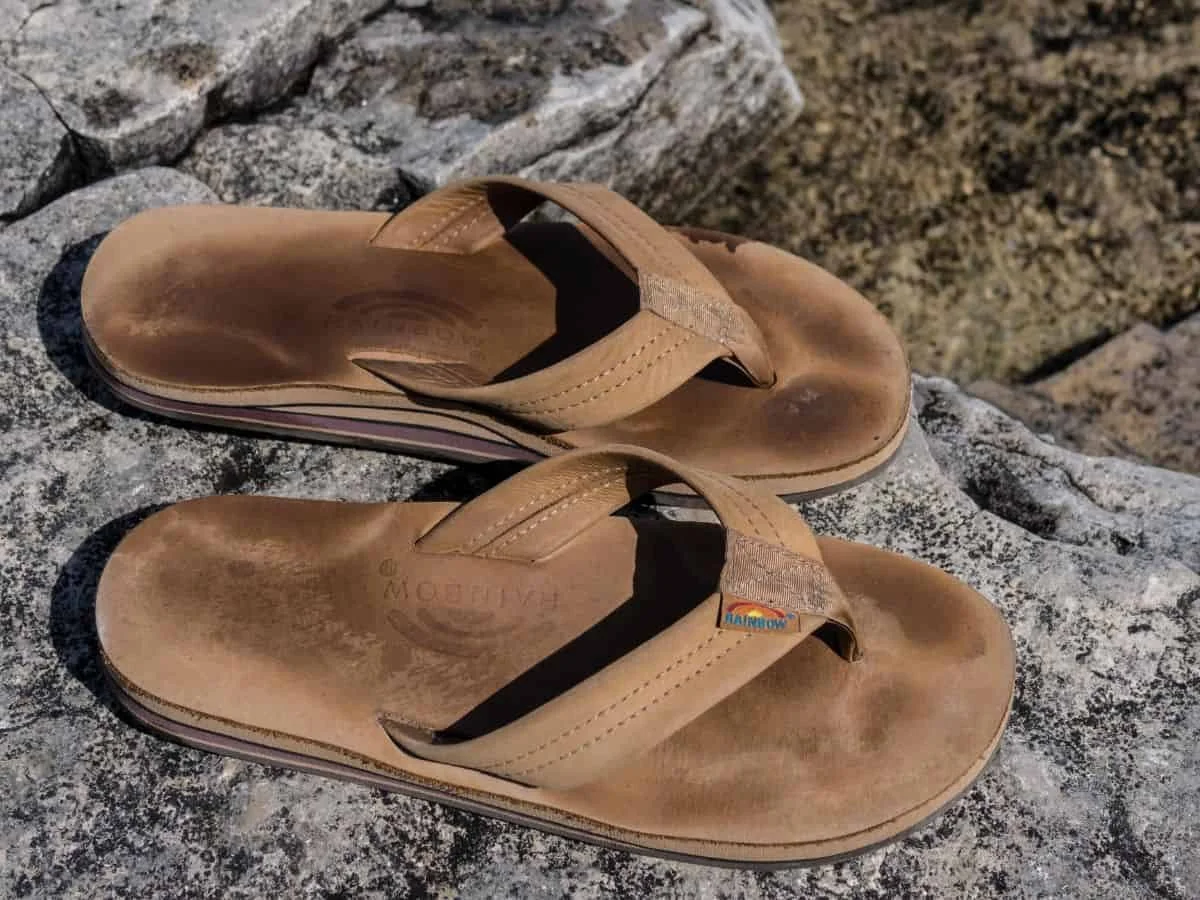
I moved to California as a lifelong sneakerhead. Everyone at my Carlsbad office wore Rainbows and talked about them like it was aSouthern Californian staple, and that it is. They talked about them with enough certainty that it made me interested enough to buy a pair in 2020. I've had 2 pairs since. Both still going.
The actual story is about a leathersmith from Laguna Beach, an EPA regulation, and how a flip-flop became one of the most obsessively defended purchases in California.
What a $200 Budget and a Parachute Stitch Built

Jay "Sparky" Longley started Rainbow Sandals in 1972 in a garage in Laguna Beach with $200. He spent it on a sewing machine manufactured for stitching parachute harnesses during World War II, a hydraulic press to die-cut soles, and a grinder for finishing the edges. Zero marketing budget because there was no marketing budget to have.
What Longley was solving was a specific and embarrassing problem: the cheap foam flip-flops everyone wore in the early seventies (called "zoris") had a catastrophic failure rate at the toe post. The strap would pull straight through the soft foam sole, leaving the wearer barefoot on hot asphalt. Longley was a leathersmith. He understood material grains, tanning processes, and the structural integrity of hides. So he approached a flip-flop the way you'd approach a hiking boot: with the same rigor, the same material standards, the same expectation that it should last.
The parachute-grade sewing machine let him introduce the "Box X" stitch at the toe post: a square with an X inside it, borrowed from aerospace engineering. That stitch distributes the tension of the wearer's stride across a wider surface area of the nylon webbing. Under normal use, the strap cannot pull through. It's damn near impossible. The nylon webbing itself is 2,000-pound test, which is a massive over-engineering for something a human foot will ever put it through, but that's kind of the whole deal.
The toe strap is folded and double-stitched with bonded nylon thread, coated in a resin that makes it hydrophobic and chemically inert to salt spray. The stitches outlast the leather. The soles use a closed-cell sponge rubber with memory properties, with layers of varying density. Viewed from the side, those layers of blue, yellow, and red foam look like a rainbow. Which is how the name happened: a description of the actual construction. [INTERNAL LINK: history of California footwear brands]
By 1974, he'd outgrown the garage and moved to San Clemente. He sold his first pairs on consignment at the Hobie surf shop through surf industry legend Dick Metz. Made 6 pairs, sold them, bought materials for 12, repeated. He was solving a problem and the market found him.
The Break-In Period Is Real and That's Exactly the Point
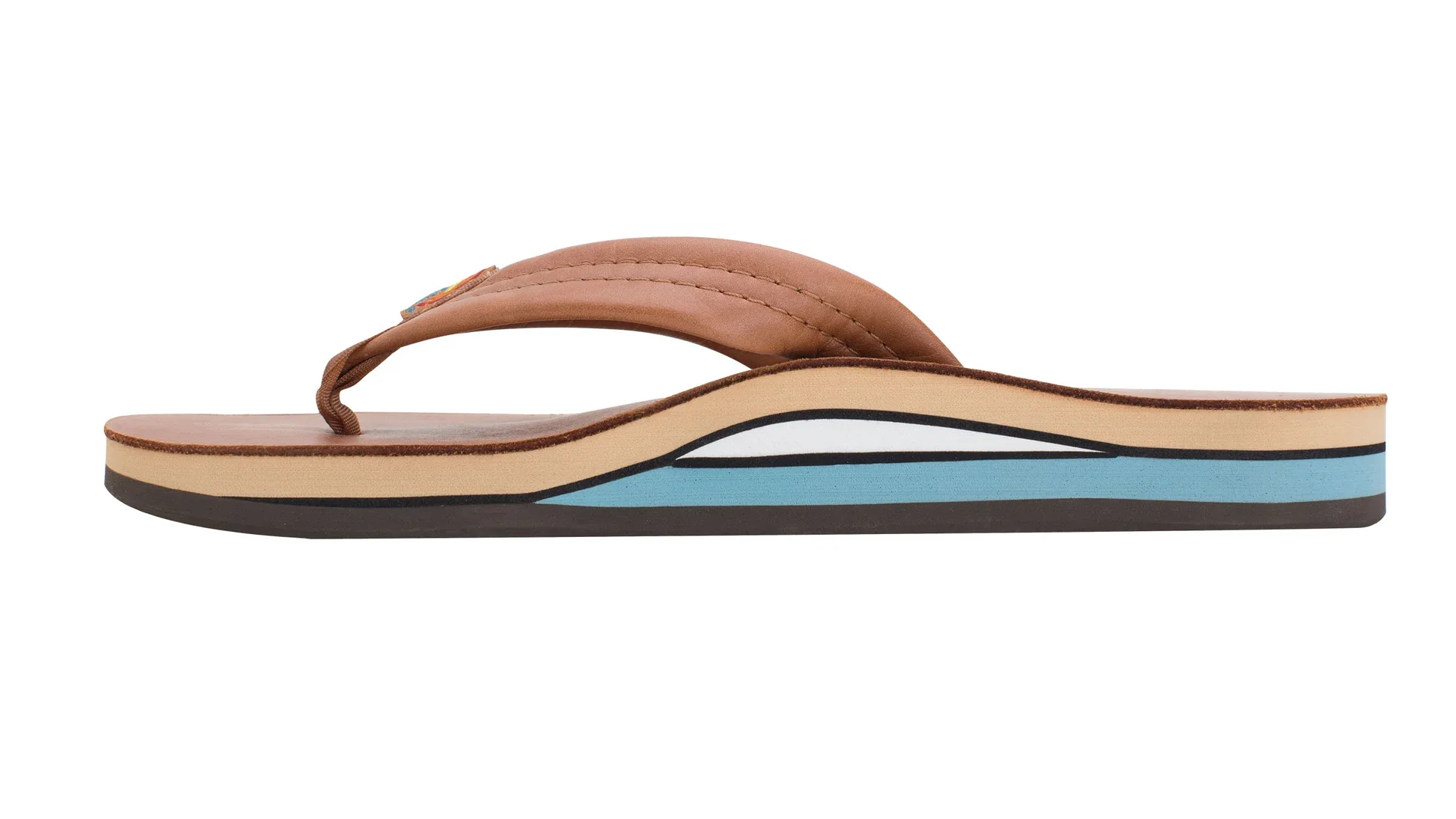
The flagship 301 Premier Leather model is designed to resist you. It forces you to break it down until it conforms to your foot specifically. That's the mechanism, and it's why the break-in period runs anywhere from 1-3 weeks of daily wear and why the Reddit threads are full of people posting their blister counts.
The closed-cell sponge rubber compresses and ruptures slowly under the specific pressure points of your heel, the ball of your foot, and your toes. The cells permanently deform, compressing under your specific weight without bouncing back. After 2-3 weeks, the footbed has developed a negative impression of your foot. A custom orthotic, basically. The friction-lock between your foot and the sandal prevents the sliding that causes blisters in most flip-flops. But only after the impression is set.
When I finally committed to mine in 2020, I wore them daily instead of swapping back to sneakers every time it got uncomfortable. The break-in was shorter than I expected. I don't know if I just finally knew what I was doing.
The cult around this break-in period is one of the more interesting things in consumer culture. People on the r/BuyItForLife subreddit used to brag about ten-year-old pairs like they were battle scars. The "shower method" (wearing them in the shower to soak the leather, then walking them dry) gets passed around like folk wisdom. The discomfort isn't just tolerated, it's framed as proof of authenticity. You suffered, therefore you belong. And yeah, it works because the payoff is real: a sandal that fits exactly your foot, that you bought off a shelf in a size medium. There's nothing else that does that for sixty-five bucks.
The "Lifetime Guarantee" Is a Trap Door
The Rainbow Guarantee is for the "lifetime of the sole." Their exact language: "The sandals will be eligible for warranty until you have worn through anywhere on the top or bottom layer of the sole." That's a tread-life warranty. The sole wears down, the warranty expires. And by the way: once the heel or toe wears to the middle foam layer, you're done. The phrase "Lifetime Guarantee" on a sixty-five-dollar sandal reasonably implies a lifetime-of-the-owner deal. The actual policy covers the tread.
It gets more specific from there. The policy covers nothing moisture-related. On a beach sandal. Rainbow explicitly excludes water damage on a product you are supposed to wear into the ocean. I mean, come on. The policy also excludes any use of leather conditioners, oils, or lotions that results in delamination. Which is tricky, because delamination (the layers separating) is exactly what customers are seeing, and the company has significant latitude to attribute it to "water damage" or "lack of care" rather than a glue failure.
In September 2023, a law firm called Kneupper & Covey filed a class-action lawsuit against Rainbow Sandals alleging the "Lifetime Guarantee" is deceptive marketing. The suit cites instances where consumers sent in delaminated sandals with ample tread remaining and got rejected because the leather "looked dry" or "water damaged." From what I can tell, the case is still working through the courts. The fact that it exists, and the way the Reddit community has turned on the brand over the last 3 years, tells you something about where things stand.
The r/BuyItForLife community, which was once a Rainbow Sandals fan club, is now dominated by threads about sandals falling apart in 6 months to 2 years. People point to the China manufacturing shift in 2002 as the inflection point, though the quality complaints spiked in the 2020s, 20 years after that move. That timeline points to recent supply chain problems or material cost-cutting. Either way, the brand's most valuable asset (the "buy it for life" credibility) is the thing now under the most pressure.
The California Regulation That Changed Everything
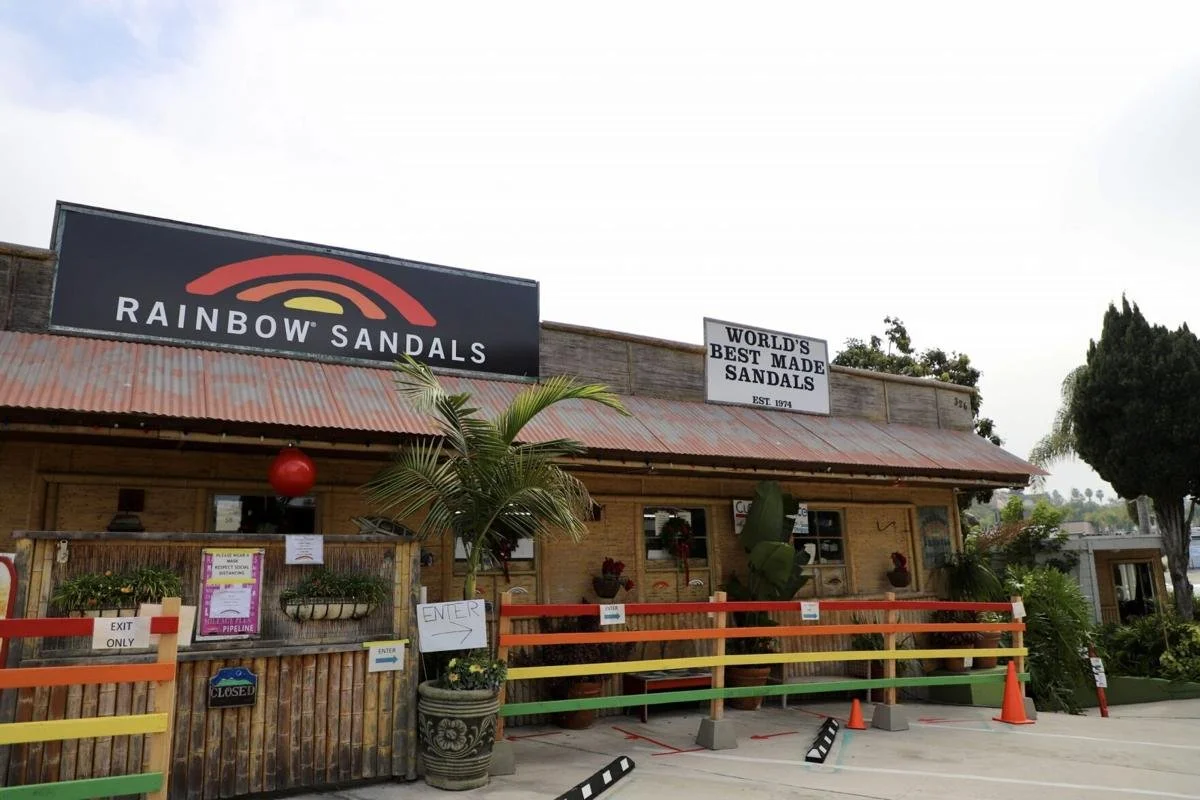
To bond the layers together, Longley formulated a proprietary glue built around Methyl Ethyl Ketone (MEK): a solvent that creates a chemical weld rather than a standard adhesive bond, and the best option available for keeping the sandal from delaminating. The problem: MEK is a Volatile Organic Compound. It contributes to ground-level ozone when it cures.
In the early 2000s, California tightened VOC emissions regulations and the San Clemente factory's output exceeded allowable limits. Longley was told he could make 1,000 pairs a day legally. Rainbow was selling 2M pairs a year. He spent $1.5M on an industrial scrubber to get emissions down to near zero. Then the fire department flagged the volume of flammable MEK stored on-site. The green glue alternatives had weaker bond strengths he felt would compromise the Lifetime Guarantee. There was no clean solution in San Clemente.
So in 2002, he moved 75% of production to China, where a different adhesive was permitted. That's the whole story behind the China pivot.
The San Clemente factory still runs today, capped at 1,000 pairs a day, producing the "Signature Series" Americana line. These are the "Made in USA" pairs. They're the pairs sold at REI and Nordstrom with the woven "Made in USA" label, the ones that let Rainbow keep the heritage story alive while the vast majority of its actual volume ships from China. The company is transparent about this if you dig for it. But the casual buyer doesn't know, and the marketing doesn't exactly lead with it.
Where the Brand Stands Now
The warranty is being litigated. The quality complaints are documented and recent. Sparky Longley is still the entire company, still traveling to China to monitor production, with no publicly announced succession plan. And somehow, people still line up to buy them. Because the engineering is real and 50 years of proof is hard to argue with. Whether the brand can protect that reputation without the person who built it is an open question.
The real story of Rainbow Sandals isn't about whether they're worth the break-in. It's about how a California air quality regulation reshaped a company's entire supply chain, and why the brand's reputation is now being tested in federal court.