

Dieter Rams Called It in 1976. Nobody Listened.
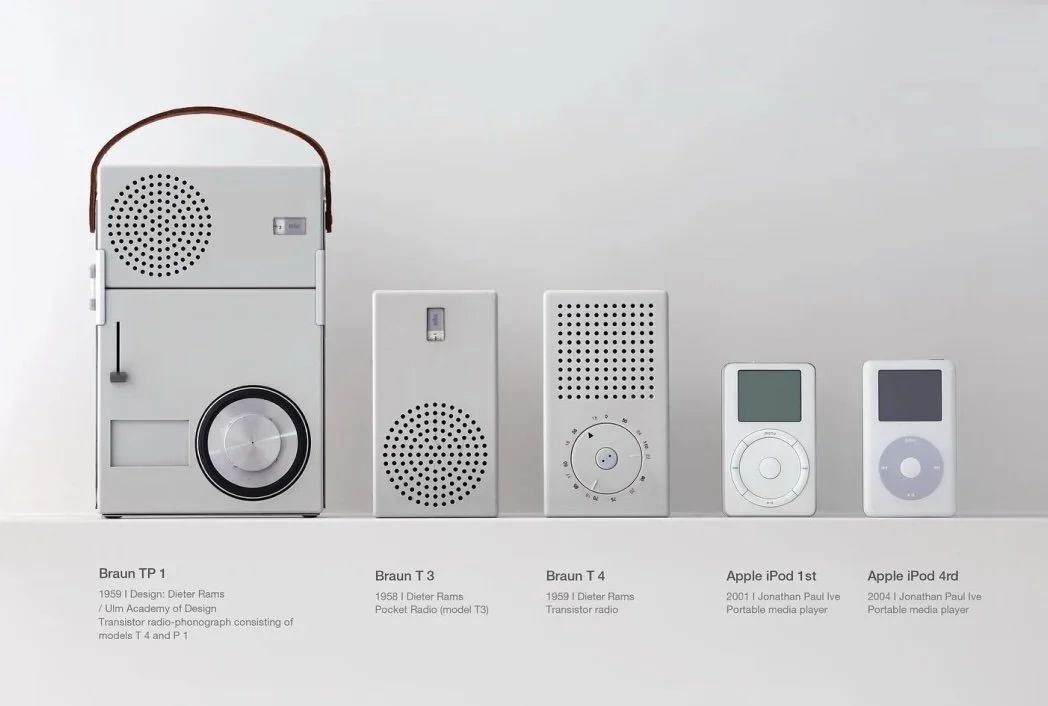
I came to Dieter Rams the wrong way. Most people do. You see the iPod sitting next to a Braun T3 pocket radio from 1958 in one of those side-by-side comparison photos, and your first reaction is "okay, Apple traced this." The resemblance is so clean it stops looking like influence and starts looking like photocopying. Wrong assumption.
The real story is more interesting and more uncomfortable. Apple studied Rams. Deeply. In the 2009 documentary Objectified, Rams acknowledged Apple as one of the few companies actually building products according to his design philosophy. He was pleased. He was also clear-eyed about how few others were doing the same.
The Carpenter's Grandson
Rams was born in Wiesbaden in 1932. His grandfather was a carpenter. When you're working in wood, there's no decorating your way out of a structural problem. The joint fits or it doesn't. Honest construction is just the job.
He trained at the Wiesbaden School of Art, graduated with honors in 1953, and joined Braun in 1955 at 23. By 1961 he was head of design. Over three decades he oversaw more than 500 products. That sounds impressive until you see what they actually were.
Snow White's Coffin
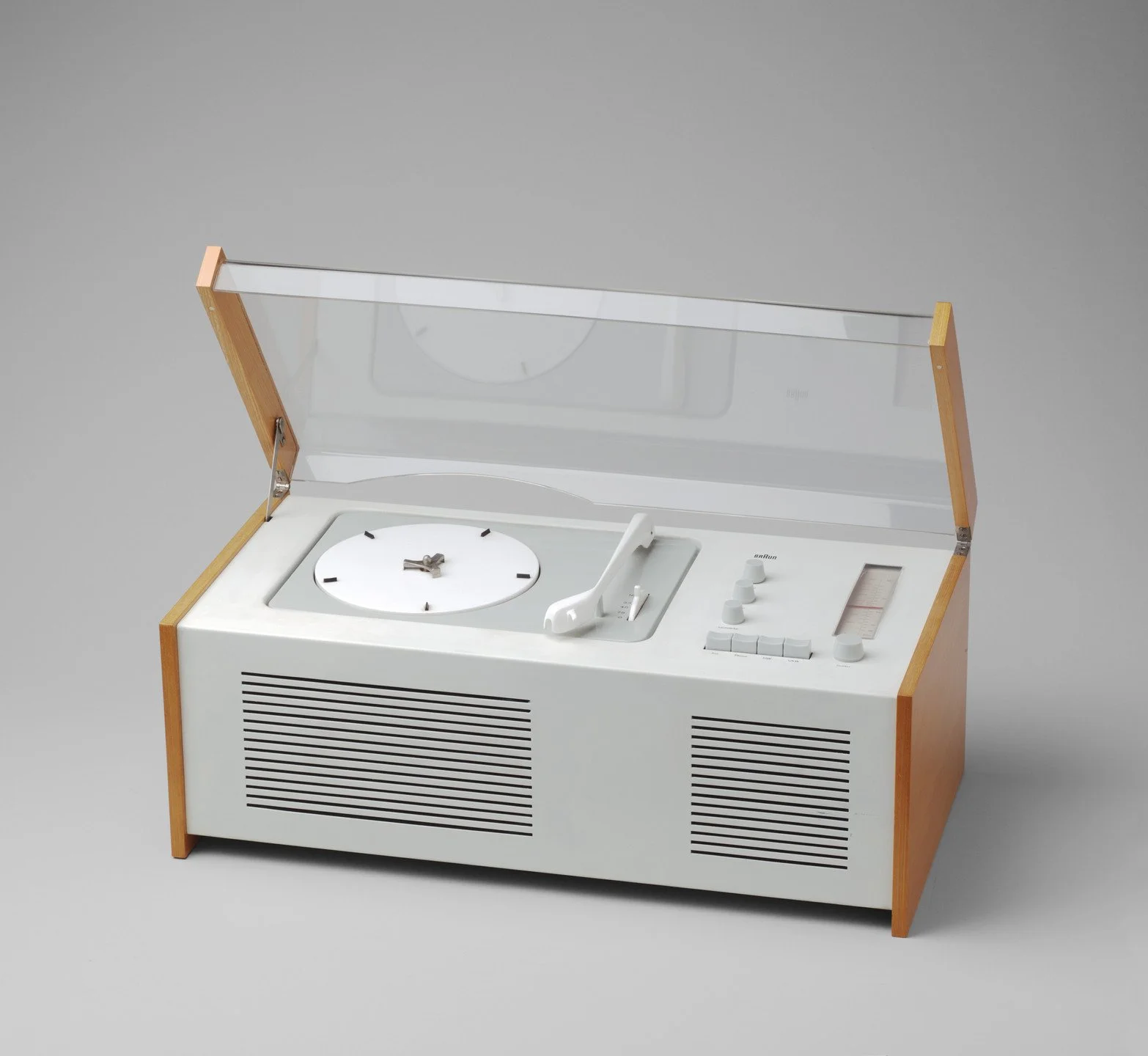
In 1956, Rams and Hans Gugelot designed the Phonosuper SK 4. Radios at the time looked like dark mahogany furniture with gold ornaments. The SK 4 came in white lacquered sheet metal with a transparent acrylic lid. Competitors nicknamed it Snow White's Coffin.
I find that kinda perfect.
The transparent lid let you watch the record spin. Frequency markings were logically laid out. Sound-emission slots were precisely sized. Every element was there for a reason. The T3 pocket radio followed in 1958. Square. Circular speaker grille. Small dial. No chrome, no status, nothing extra. Jonathan Ive recalled his parents' citromatic juicer as the moment a product's "reason for being" became understandable through form alone. That's the T3.
The Vitsoe 606 Universal Shelving System launched in 1960, still in production today. Modular, replaceable, built for extreme longevity. Users could add or replace parts over decades rather than discard the whole unit.
Dieter Rams' Design Philosophy Was a Moral Argument First
In the late 1970s, Rams described seeing an "impenetrable confusion of forms, colors, and noises" and asked himself: is my design good design?
His answer was the Ten Principles of Good Design. Good design is innovative, useful, aesthetic, understandable, unobtrusive, honest, long-lasting, thorough down to the last detail, environmentally friendly, and as little design as possible.
Read them as a checklist and you miss the argument. These are a moral position on what designers owe the people who live with their work. Principle six says good design is honest: no making a product appear more innovative than it actually is. Principle seven is long-lasting, a direct shot at planned obsolescence. Principle nine is environmentally friendly. Rams was a pioneer on this, advocating for an end to the "age of waste" before sustainability was anywhere on the industry's radar.
The tenth principle is the one on the poster in every design student's apartment: good design is as little design as possible. Less, but better. Weniger, aber besser. The first nine explain why the tenth is true.

Apple Got It. And Then Look at Everything Else.
Jobs cited Braun's clean approach as early as 1983, predicting the heavy dark "high-tech" look would give way to something purer, "much like Braun does with its electronics." The iOS calculator was a direct translation of the 1987 Braun ET66: soft round buttons, distinct layout. The original Podcast app mimicked the Braun TG 60 tape recorder. Ive named the influence explicitly and repeatedly.
Apple's success, Rams acknowledged, proved his principles could scale globally. One of the few companies getting it right.
The companies that followed Apple into that market followed Apple's price points and market share ambitions, full stop. For my money, the result is exactly what Rams described in that 1976 New York speech: a "chaos of assorted junk," things built without honest consideration for the people who'd live with them. He predicted future generations would "shudder at the thoughtlessness" with which his contemporaries filled their homes. He was describing 1976.
The Part Where He Said He'd Pass on the Whole Thing
Here's what I can't shake. In a documentary, Rams said if he could do it over, he wouldn't want to be a designer. He cited the chaos of assorted junk, the thoughtlessness, the very things he'd spent his career fighting.
He'd spent three decades designing things to last, fighting planned obsolescence, arguing that honesty in design was non-negotiable. The market responded by building planned obsolescence into the product specs, developing dark patterns (interfaces engineered to manipulate users into actions they didn't intend), and calling it progress. He was calling for an "end to the era of wastefulness" in 1976. The throwaway society he warned about has only gotten more intense.
The architecture of his thinking is airtight. The world he designed for never arrived.
What He Was Actually Saying All Along
The Ten Principles are a moral position on what you owe the people who live with your work, not an aesthetic checklist. Indifference toward people and their reality is, for Rams, the cardinal sin in design. Everything else follows.
The design community hangs the principles on the wall and builds products that contradict them anyway. The products still break on schedule by design.
Rams saw that coming in 1976. Said so in a New York speech. Then spent fifty years watching the world fill up with junk anyway.
I don't know if that makes him a prophet or a cautionary tale about right ideas in wrong moments. Maybe both. Either way, the principles hold. Every product you've ever actually loved proved it.